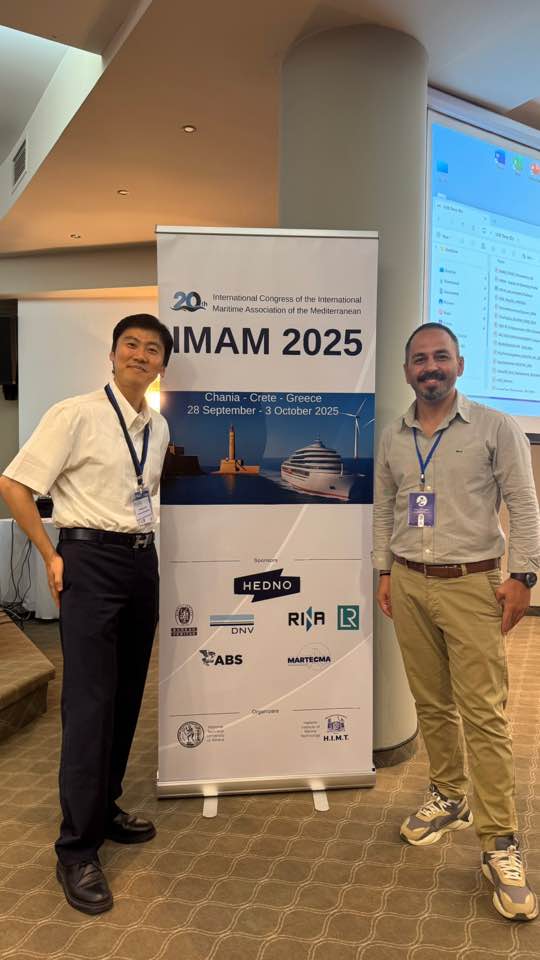
The SAFeCRAFT consortium participated at the IMAM 2025 Conference in Crete, Greece, from the 28th of September to the 3rd of October 2025, a major international forum organised by the International Maritime Association of the Mediterranean (IMAM). The conference brought together researchers and professionals to explore the latest developments in ship design, safety, and marine innovation.
During the event, representatives from the University of Strathclyde (UoS), in collaboration with Hydrus Engineering S.A. and the National Technical University of Athens (NTUA), presented:
“Hazard Identification for Quantitative Risk Assessment of Compressed Hydrogen as a Marine Fuel in the SAFeCRAFT Project.”
The presentation focused on the systematic identification and assessment of hazards associated with the use of compressed hydrogen as a marine fuel, forming the basis for a robust quantitative risk assessment (QRA) within the SAFeCRAFT project. This research supports the development of a risk-based design framework for hydrogen systems onboard ships, providing technical insights to guide safe design and compliance with emerging regulations and class requirements.
A key component of the study was the HAZID workshop held in Athens from 10–12 February 2025, where experts from the consortium systematically identified 161 hazards across six system nodes: bunker station (30), fuel storage (35), fuel supply unit (20), generator engine (38), gas and vent system (16), and PTI/PTO (22). These results provide the foundation for the next stage of the Quantitative Risk Assessment (QRA) and inform design recommendations for safer hydrogen systems.
Building on the HAZID outcomes, the planned QRA scenarios address representative hydrogen-related risks, including H₂ releases at vent masts, leaks in fuel preparation spaces, emergency shutdown (ESD) activations, storage damage during cargo operations, jet-fire and detonation events, and the definition of safe bunkering zones. These analyses will guide design validation and regulatory alignment, with particular focus on venting configurations and safe distance evaluations using computational fluid dynamics (CFD).
The presentation was delivered by Injun Yang, Byongug Jeong, Peilin Zhou, Haibin Wang, Ana Mesbahi, Insik Hwang, Kyeoungmin Park, Hayoung Jang, and Yoon Choi from the University of Strathclyde, together with Nicholas Tsouvalis, Christos Papadopoulos, Kyriakos Charalampakis, and Eva Kostidi from NTUA, and Astrinos Papadakis, Dimitrios Vlachos, Konstantinos Sykaras, and Ioannis Gergis from Hydrus Engineering S.A. Their joint work reflects SAFeCRAFT’s commitment to advancing hydrogen safety knowledge and supporting the maritime sector’s transition toward the safe, sustainable, and efficient integration of alternative fuels.