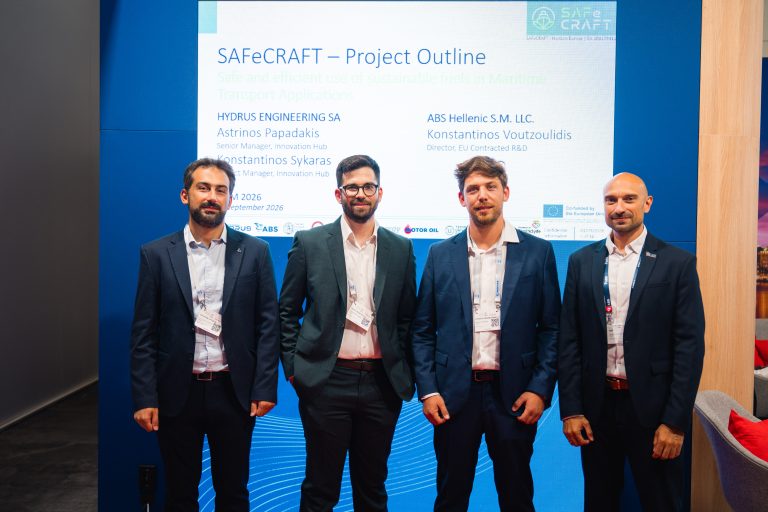
The SAFeCRAFT Project successfully held its Posidonia 2026 event, “Advances in the SAFeCRAFT Project and the Outlook for SAFs in the Waterborne Sector,” on Wednesday, 3 June 2026, at the Metropolitan EXPO in Athens, Greece.
Bringing together over 60 participants from across the maritime sector, the event created a dynamic forum for discussing one of the most pressing questions facing waterborne transport today: how can Sustainable Alternative Fuels move from promising solutions to safe, efficient and scalable deployment?
The strong attendance and active participation reflected the sector’s growing interest in practical decarbonisation pathways, as well as the need for continued collaboration between industry, research, classification societies, shipowners, fuel providers, shipyards, technology developers and policy stakeholders.
The event opened with a series of focused presentations highlighting the latest progress and technical developments of the SAFeCRAFT Project.
Astrinos Papadakis, Senior Innovation Hub Manager and Project Coordinator at HYDRUS Engineering SA, presented the SAFeCRAFT Project and its contribution to the safe and efficient use of sustainable fuels in maritime transport applications.
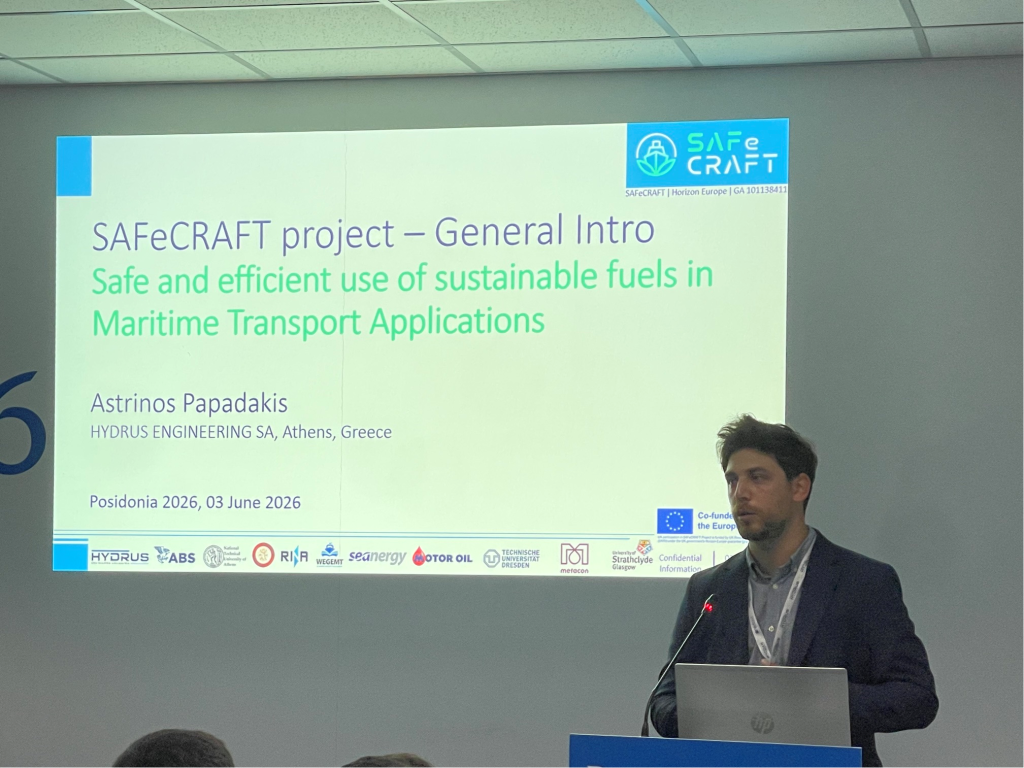
Astrinos Papadakis, Senior Innovation Hub Manager at HYDRUS Engineering S.A.
Konstantinos Sykaras, Innovation Hub Senior Engineer at HYDRUS Engineering SA, followed with a presentation on the SAFeCRAFT full-scale demonstration of propulsion power coverage onboard a Capesize bulk carrier, offering insights into the project’s demonstration activities and technical direction.

Konstantinos Sykaras, Senior Engineer at Hydrus Engineering SA
The programme continued with Dr George Rossopoulos from the School of Naval Architecture and Marine Engineering at the National Technical University of Athens (NTUA), who presented the project’s holistic assessment of alternative systems for additional ship types through desktop studies.

Dr George Rossopoulos, School of Naval Architecture and Marine Engineering at the National Technical University of Athens (NTUA)
The presentation session concluded with Alexandros Vasilakis, Project Engineer at Seanergy Shipmanagement Corp., who shared end-user considerations and brought an operational perspective to the discussion on the practical implementation of sustainable alternative fuel solutions.

Alexandros Vasilakis, Project Engineer at Seanergy Shipmanagement Corp.
Together, the presentations showed how SAFeCRAFT is approaching the transition to sustainable fuels through technical assessment, demonstration work, operational input and cross-sector collaboration.
A key highlight of the event was the panel discussion on “SAFs and energy efficiency technologies towards decarbonisation: Challenges, Opportunities and Lessons Learned.” The discussion was moderated by Professor Dimitrios Lyridis from the School of Naval Architecture and Marine Engineering at NTUA.
The panel brought together representatives from across the maritime value chain: Konstantinos Voutzoulidis from ABS, Vasileios Petousis from Seanergy Shipmanagement, Konstantinos Chatzifotis representing Motor Oil Group, Christos Papaleonidas from WMG, and Dimitrios Svoronos from Resolute Maritime Services.

Professor Dimitrios Lyridis from the School of Naval Architecture and Marine Engineering at NTUA
The discussion made clear that the deployment of Sustainable Alternative Fuels will not depend on a single breakthrough. Instead, progress will require the alignment of several critical factors: fuel performance, cost, infrastructure, bunkering, regulation, shipyard capabilities, approval pathways, technology readiness, stakeholder engagement and operational confidence.
One of the strongest messages emerging from the panel was that efficiency remains central to fuel adoption. Mr Vasileios Petousis highlighted that, as has always been the case in shipping, efficiency is a key driver. A fuel must not only be sustainable; it must also offer usable energy at a competitive cost and be practical for real maritime operations.

Vasileios Petousis, Energy &Sustainability Manager at Seanergy Shipmanagement Corp.
The discussion also underlined the importance of looking beyond the vessel itself. Mr. Konstantinos Chatzifotis emphasised the need for a fully integrated value chain, from production and transportation to distribution and the final offtaker. In the case of fuels such as hydrogen, this means considering not only onboard use, but also how the fuel reaches the port, how it is bunkered, how it fits into the wider port ecosystem and how costs are assessed from end to end.

Konstantinos Chatzifotis, EU Affairs Manager at Motor Oil Group
The importance of meaningful indicators and early stakeholder engagement was also highlighted. Dr. Christos Papaleonidas stressed that Key Performance Indicators (KPI’s) should not be treated simply as reporting tools at the end of a project. Instead, they should be used during implementation to engage stakeholders early, gather feedback and demonstrate how project outcomes relate to specific operational realities.
Dr. Papaleonidas also underlined the need to communicate the benefits of sustainable fuel solutions in a clear, specific and quantifiable way. Different stakeholders, from shipowners and operators to fuel producers, project developers and infrastructure providers, need to understand the value of each solution from their own perspective. Demonstrating long-term benefits, linking them to infrastructure needs and providing regulatory assurance were presented as essential steps for building confidence and encouraging adoption.

Christos Papaleonidas, CEO at WMG Sustainable Innovation
The role of shipyards was also highlighted as a key part of the transition. Mr. Dimitrios Svoronos noted that shipyards around the world hold different areas of expertise and knowledge, and that this diversity can support the development and implementation of emerging maritime technologies.

Dimitrios Svoronos from Resolute Maritime Services
The panel also addressed the pathway from early-stage approval to wider deployment. Konstantinos Voutzoulidis stressed that moving from Approval in Principle (AiP) to higher Technology Readiness Levels (TRL) is a multi-stakeholder process. Fuel producers, shipyards, owners and other stakeholders need to be aligned for solutions to materialise in practice.
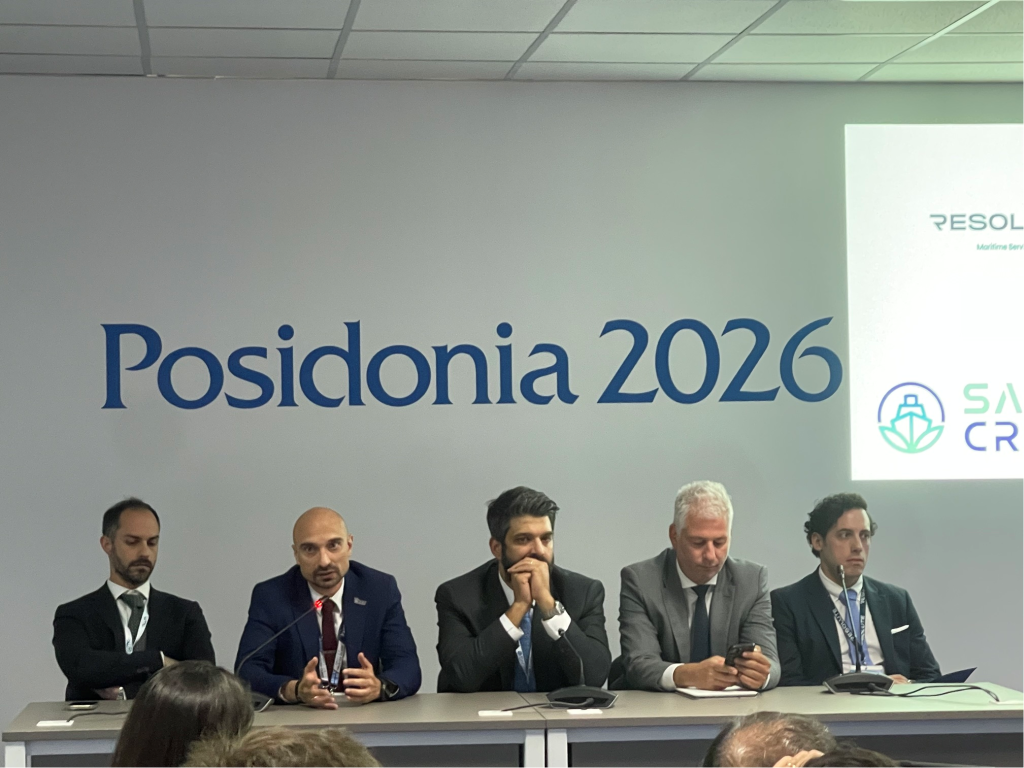
Konstantinos Voutzoulidis, Maritime Executive | Expert in Funding, Innovation, and Classification | Business Development Director of Europe, Contracted R&D at ABS
These contributions reinforced a clear message: Sustainable Alternative Fuels are a vital part of the decarbonisation pathway, but their successful deployment will depend on more than fuel innovation alone. It will require scalable infrastructure, robust safety assessment, regulatory clarity, investment confidence, operational readiness, meaningful performance indicators and strong cooperation across the full maritime value chain.
The SAFeCRAFT Posidonia event provided a valuable platform for dialogue between research, industry and operational stakeholders. It highlighted both the promise and the complexity of Sustainable Alternative Fuels, while demonstrating the importance of collaborative projects such as SAFeCRAFT in supporting the transition towards safer, more efficient and more sustainable maritime transport. 
The SAFeCRAFT consortium warmly thanks all speakers, panellists, participants and stakeholders who contributed to the success of the event. Their engagement helped make the session a highly successful exchange on the future of sustainable fuels and energy efficiency technologies in the waterborne sector.
SAFeCRAFT looks forward to continuing this dialogue and sharing further progress on practical pathways for the safe and efficient use of sustainable fuels in maritime transport.